
Mevlevi Tekke Museum of Whirling Dervishes
Nicosia, North Cyprus
 |
| The Mevlevi Tekke |
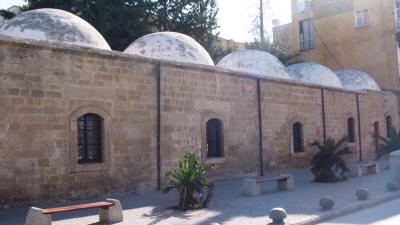
The Mevlevi Tekke in Lefkosa was an important cultural centre of the Ottoman era in Cyprus. It is situated within the walled city, south of the Kyrenia gate on the main street leading to Ataturk Square. It is distinguished by 6 golden domes surmounting a rectangular building.
Built in the 17th Century on land donated by Emine Hatun, it is believed that the present Mevlevihane is a continuation of a previously established Tekke known as the Arab Ahmed or Ferhed Pasha Tekke.
 |
| Ottoman Tombstones |
The Mevlevi order was founded by the poet Mevlana Celaleddin Rumi, who was born in 1207 in what is now Afghanistan. While he was still a boy, his parents emigrated to Anatolia and settled in Konya. There he studied under his father, and at the age of 24 became a professor of history, theology and jurisprudence.
The mystical philosophy that he express in his poetry and bequeathed to the Mevlevi order would spread east from Konya as far as India, and then throughout the entire Islamic world. His teachings emphasised the individual soul's separation from God during earthly existence, and the power of Divine Love to draw it back to the infinite on death.
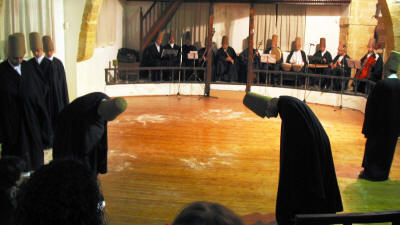
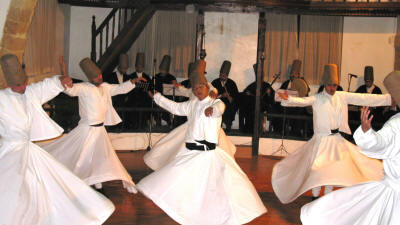
Quite scandalously to orthodox Muslims at the time, Rumi stressed music and dance as an expression of this mutual love and yearning, and the Mevlevi order became famous over the centuries for its whirling ceremony. In Cyprus, the Lefkosa Mevlevihane was the centre of the Sufi tradition on the island. It is believed that the mufti of Cyprus, who came from Konya in 1607 was also the first Sheik of the Mevlevihane.
 |
| The Sema Ceremony |
The Tekkes in the Turkish republic were closed by decree in 1925, and the centre of the Mevlevi order moved from Konya to Aleppo in Syria. Although the majority of Turkish Cypriots were in favour of the closure of the Tekkes in Cyprus, the British colonial administration on the island allowed the tradition to continue. The next sheik for the Tekke in Lefkosa would be sent from Aleppo rather from Konya, but his death in 1954 ended an era in which the whirling dervishes had performed their sacred dance in the Mevlevihane.
When it was first built, the Mevlevihane included a complex of buildings and extensive grounds. There was a kitchen which provided food for the poor of the city. There was accommodation for 18 dervishes and guest rooms for visitors. Beneath the domes were tombs for deceased sheiks. There was an inner courtyard for contemplation, and an orchard in which almonds, pomegranates and figs provided fruit. An ancient well and a reservoir provided water, and there was an octagonal fountain for ablutions.
 |
| Whirling Dervishes |
In 1956, the residential section of the Tekke was converted into a hostel for Turkish children under care. Then in 1961, on the recommendation of the director of the Konya museum, the Tekke was closed entirely. After alterations, it was opened as the Cyprus Turkish Museum in 1963, exhibiting calligraphy, imperial edicts and weapons as well as costumes of Mevlevi dervishes and tombstones. What remains of the original Tekke is the semahane, where the dervishes performed their dance, and the tombs of the sheiks. Almost everything else was demolished when a shopping centre was erected in 1970.
After extensive repairs to the semahane and the tombs of the sheiks, the Mevlevi Museum was formally opened on the 17th December 2002, with dervishes whirling once again after an interval of over 40 years. This date was the anniversary of the death of Celaleddin Rumi, and as part of the Turkish Cypriot heritage, this ceremony will be performed every year around the 17th December.
 |
| Tombs of the Sheiks |
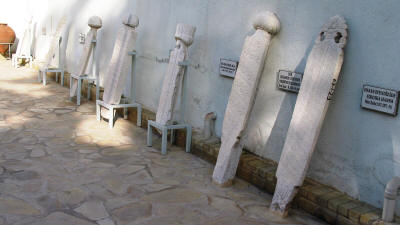
The Mevlevihane is entered through an arched doorway, above which an Ottoman inscription informs the visitor that this is the house of the Mevlana. Behind the doorway is a courtyard in which exquisitely carved examples of Ottoman tombstones are displayed. These stones have been collected from various locations in Cyprus, and date from the 18th to the 20th century. Although they are all Ottoman in style, many incorporate classical, rococo and modern elements. To the right stands the semahane, which is entered through an arched doorway on the eastern wall. The beams of the wooden ceiling of the semahane rest on two square columns and a series of arches dividing the room into two sections. The first room contains an exhibition of Rumi's greatest poem, the Mesnevi, along with reproductions of Ottoman miniatures and other illustrations. To the left of the entrance stands the only remaining dervish cell, in which cooking utensils, a table, and other objects used by the dervishes are displayed.
The second room in the semahane contains the mihrab, a niche indicating the direction of Mecca. The floor on which the dervishes danced is lower and of oval shape. Along the northern wall is a balcony where the musicians performed. On the floor of the semahane, copies of the Mesnevi are displayed, along with musical instruments and costumes worn by the dervishes when they danced.
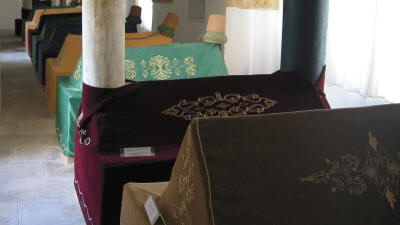
Through the doorway next to the mihrab one enters the chamber in which the sheiks of the Mevlevihane lie buried. There are 16 tombs beneath six domes, extending south along the Kyrenia Street. Photographs of some of the sheiks, manuscripts and other objects are displayed on the walls, while the tombs themselves are covered in embroidered textiles.
See location in Google maps.
Back to Nicosia Index.