
A Brief History of Cyprus
Venetian Period (1489 - 1571)
The Venetian desire for Cyprus was inspired purely by profit. The Venetians saw Cyprus primarily as a military base. Anticipating conflict, they undertook an ambitious plan of fortification. Famagusta and Nicosia were ringed with massive earthworks, cased with stone. An outer wall was erected around Kyrenia castle, the gap being filled with earth to form an artillery rampart. The best military architects in Europe were brought in to design and execute these projects.
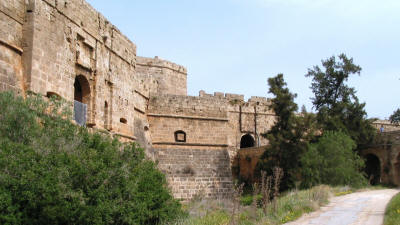 |
| The Venetian Walls of Famagusta |
Cypriots were seen merely as a populous to be taxed as much as possible. The island was well endowed with the timber essential for shipbuilding, and formed an ideal base from which the Venetians could dominate trade with the east. They continued to pay the tribute enforced upon Cyprus by the Mamluks, and when the latter were conquered by the Ottomans, the tribute was redirected to Constantinople, the seat of Ottoman power since 1453.
Taking over the leadership of the Ottoman Empire from his father, Sultan Selim II repeatedly complained to the Venetians and demanded an end to the piracy in the seas surrounding Cyprus. The Venetians refused to do this and ignored the demand of Sultan to have full control of the island.
These relations were exacerbated by the Venetian seizure of Turkish ships, execution of Turkish corsairs in violation of an Ottoman-Venetian Treaty, and the continuing presence of Maltese pirates in Venetian ports harassing Muslim pilgrims and interfering in general commerce. Therefore, the Sultan decided to intervene and put an end to this state of affairs, as well as to consolidate the Ottoman control of the East in general. In 1570, after an ultimatum had expired, hordes of Ottoman troops landed at Larnaca, under Lala Mustapha Pasha. Nicosia was besieged, and resisted for six weeks, refusing terms of honourable surrender on rumours of an approaching Venetian fleet. The city was eventually taken by storm, and sacked, 20,000 inhabitants being massacred in the process. Kyrenia capitulated without a struggle.
In October, Lila Mustapha Pasha with an army of 200,000 began the siege of Famagusta. The beleaguered party received meagre reinforcements in January 1571, when the Turkish fleet withdrew to winter anchorage, but after ten months the garrison was reduced to 1500 men, whilst 80,000 Ottoman soldiers had perished. On August 1st, terms of capitulation were agreed between the captain of Famagusta, Marc Antonio Bragadino, and Lala Mustapha Pasha. However, a dispute arose and some incautious words by Bragadino resulted in his being flayed alive. In spite of a naval reversal at Lepanto on the Adriatic coast on 7 October 1571, Selim's efforts were successful and the Venetians had to sue for peace.
Later that month Venetian officials handed over the island together With 300,000 ducats for war reparation.
It is said that Venetian rule was so unpleasant that when the Ottomans arrived in Cyprus in 1571 the locals felt as if they had been liberated from slavery.