
Famagusta (Gazimagusa)
North Cyprus
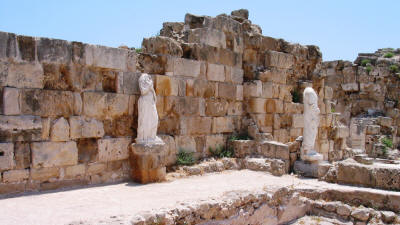 |
| Salamis Statues |
The town of Famagusta was originally a small commercial port and fishing village. The name of the city in Turkish is Gazimagusa, and in Greek, Ammokhostos. The name Famagusta is a Frankish corruption of the Greek name. It lies on the eastern coast in a bay between capes Greco and Eloea, and possesses the deepest harbour in Cyprus.
Much of the history of the town is obscure as there are no written records, and our only source material is from travellers' accounts of merchants passing through. It is believed that the city occupies the site of the ancient town of Arsinoe.
To the north of Famagusta lie the ruins of Salamis. This city is believed to have been founded in the 11th Century BC, being abandoned in 648AD after the combined catastrophes of earthquakes and raids by Arab pirates. The population of Salamis then moved to Famagusta.
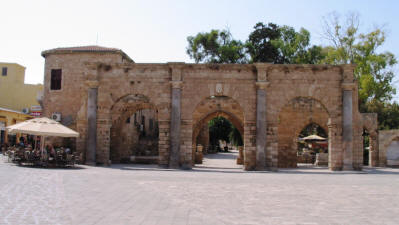 |
| The Venetian Palace |
In 1291, an influx of Christian refugees fleeing the downfall of Acre in Palestine transformed it from a tiny village into one of the richest cities in Christendom. By the year 1300, the town was one of the principal markets in the eastern Mediterranean, and headquarters of many Christian religious orders, as can be seen by the many churches of several denominations that can still be seen today.
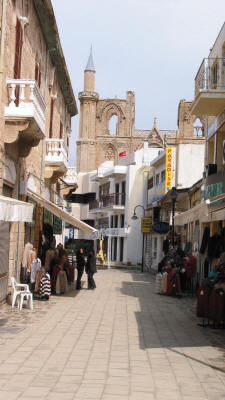 |
| A Famagusta Street |
In 1372, the port was seized by the Genoese. Rivalries between the Genoese and the Venetians made for an unsteady peace, however the island as a whole was still under the rule of the Lusignans. This came to an end when the last Lusignan king conveniently died at the age of one, leaving no heir. His mother, who was Venetian, was persuaded to hand over the kingdom to the Venetians and in 1489 they assumed control of the island, moving the capital from Nicosia to Famagusta, ruling the entire island from there.
The Venetians saw Cyprus as a military base, and spent their time on the island fortifying the major cities. The invention of gunpowder and the use of cannon made the existing defences obsolete, and the Venetians remodelled the defences for the use of artillery. The medieval square towers were replaced with round ones, and all along the walls and citadels cannon portholes were inserted. Most of this fortification can be still be seen; indeed the Land Gate (Ravelin), is the main pedestrian entrance into the old city to this day.
Relations between the Venetians and the Ottomans were stressful to say the least. Venetian seizure of Turkish ships, execution of Turkish corsairs in violation of an Ottoman-Venetian Treaty, and the continuing presence of Maltese pirates in Venetian ports harassing Muslim pilgrims and interfering in general commerce, finally caused the Sultan to intervene.
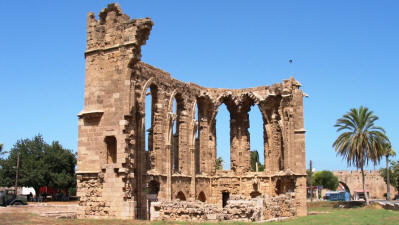 |
| St George of the Latins Church |
He acted to put an end to this state of affairs, as well as to consolidate the Ottoman control of the East in general. In 1570, an Ottoman armada placed the town under a siege which lasted from January to October 1571, by which time, Cyprus came under the total control of the Ottomans.
Ravished by war and earthquakes, the old walled town is now only partially inhabited, but it contains some of the finest examples of medieval military architecture still existent today, as well as the 14th Century Gothic style St Nicholas Cathedral, now a mosque.
Outside the city, the spectacular ruins of Salamis give an insight into long-lost civilisations, and include a magnificent amphitheatre, Roman baths, a gymnasium and royal tombs. Inland from Famagusta are the church and monastery of St Barnabas, who was martyred at Salamis in 52 AD. The church has been preserved as it was when it was abandoned in 1976. There is a wonderful collection of 18th Century icons inside the church, and the monastery cloisters now house an archaeological museum.
At the end of June every year, Famagusta plays host to a world renowned Culture and Arts Festival.
In 2007, Famagusta was listed as an endangered heritage site by the World Monument Fund.
For an overview of the city, have a look at the Famagusta Video.
For a comprehensive list of places to visit, look at our Places of Interest section.