
A Brief History of Cyprus
Early History (Before 325BC)
Cyprus, the third largest island of the Mediterranean, and standing on the border of the Eastern and Western worlds has always captured the interests and attentions of more powerful outside forces. Over the centuries, the island has been ruled by the Assyrians, Phoenicians, Persians, Greeks, Egyptians, Romans and Byzantines from the ancient world. The middle ages saw the Crusaders, Lusignans, the Genoese and the Venetians in charge, while in more recent times, it was the turn of the Ottomans and the British. Even today, while theoretically independent, the Greeks, Turks, Europe and the USA all try to extend their influence over the island.
Over the centuries, Cyprus has had many names, but it thought that the origin of the name is from the ancient word for Copper (Kypros) which was abundant on the island.
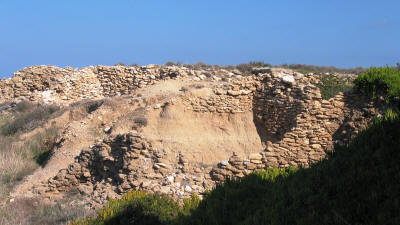 |
| The Settlement at Vrysi |
No one knows for certain when the first inhabitants arrived on the island, but traces of settlement go back to over 8000 BC, and a settlement has been found at Vrysi, east of Kyrenia.
During the Early Bronze Age the first towns and economic centres developed in Cyprus where copper was worked and exported. An influx of immigrants from Anatolia, who were displaced from their settlements in Asia Minor by invading tribes, resulted in the island developing commercial and cultural relations with Asia Minor, Egypt, and the Syrian/Palestinian region.
Most of our knowledge of this period is derived from finds in cemeteries, for although the island seems to have been thickly populated at this time, no settlements have yet been identified. Judging by the multitude of articles placed with the dead - bowls, jugs, food, combs, knives, necklaces, etc. - the afterlife was evidently an important cultural feature of these Bronze Age people.
The Middle Bronze Age (1900-1600 BC) is marked by an upsurge in cultural and trading contacts with neighbouring countries. Copper was now a major export commodity, supporting the development of large towns such as Enkomi, near present day Famagusta. Indeed some scholars believe that Enkomi is the copper rich Alasia referred to in Assyrian and Babylonian texts.
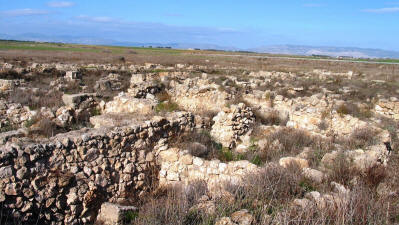 |
| The City of Enkomi |
Parallel to this increasing prosperity was a growing insecurity on the island caused perhaps by internal conflict, or influenced by events on mainland, where the Hyksos had overrun Egypt, Palestine and Syria. Fortresses began to appear such as that at Krini, and in the Karpaz peninsular.
The destruction of the Hyksos Kingdom and the revival of Egypt as the leading power in the eastern Mediterranean created for Cyprus, at the beginning of the Late Bronze Age (1650-1050BC), favourable circumstances for its development into a flourishing commercial centre. The island also became a stepping stone for eastern and western cultural exchange.
The advent of Mycenaean traders introduced a Greek element which left a permanent imprint on the cultural development of the island, which entered into a fruitful dialogue with the neighbouring oriental cultures.
The transition to the Iron Age was for Cyprus, as for Greece, a dark age. Natural catastrophes destroyed nearly all the Late Bronze Age settlements and led to a cultural decline, poverty, and a slump in population.
It was not until the arrival of the Phoenicians that the island received a cultural impulse, resulting in strengthened links with the Orient. The colonisers arrived in Cyprus from Tyre in the 9th century BC, and came to dominate the city states of Idalion, Amathus, Kition and Laphitos.
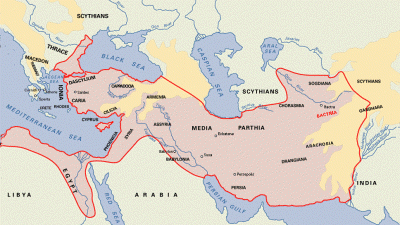 |
| The Persian Empire around 490BC |
In the 8th century BC, Cyprus was once more drawn into the realm of the Near-Eastern powers. Cypriot cities paid tribute to the Assyrian Kingdom, and after an Egyptian interlude (560 - 525 BC), they were incorporated into the Persian Empire. Their Persian masters allowed the Cypriot cities considerable latitude, and created favourable conditions for an economic and cultural resurgence. Owing to its geographical position, and its natural wealth in copper and wood, the island flourished.
The uprising of the coastal towns of Asia Minor against the Persians in 499 BC led to a polarisation in Cyprus of the pro Greek and pro Persian cities. Matters came to a head when the pro Persian king of Salamis was deposed by his younger brother Onesilos, who gathered island wide support to throw off the Persian yoke. The revolt was crushed and Onesilos perished.
The Delian League, an association of Greek City States set up by Athens to regain territory lost to the Persians, saw Cyprus important both strategically, and as a source of materials, especially timber. In 478 BC, Pausanias the Spartan succeeded in temporarily liberating large parts of the island, but this and subsequent attempts ultimately failed.
At the end of the 5th century BC, Evagoras seized the throne of Salamis from the Persian puppet Abdemon. Whilst maintaining good relations with the Persians, Evagoras promoted Greek culture, and developed Salamis into a thriving and powerful city. However, when he tried to extend his authority throughout Cyprus, the Persians intervened, and after assistance from Athens and Egypt evaporated, he eventually capitulated. He retained possession of Salamis, paying tribute the king of Persia.