
A Brief History of Cyprus
Roman Period (58BC - 330AD)
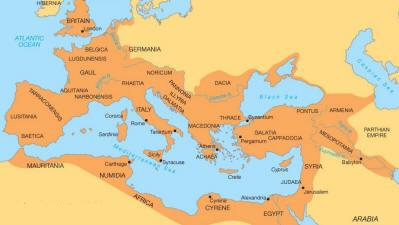 |
| The Roman Empire at its Height |
The decline of the Hellenistic states coincided with the rise of Rome as a regional power. The period of some 30 years up to 30 BC was marked by the struggle for power in Rome. The senate had lost its authority to the generals, who strove amongst themselves for supreme power. Julius Caesar eventually assumed the dictatorship, determined to reform the government of the empire. His assassination in 44 BC was followed by disorder until Octavian, Caesar's great nephew ascended to power as Emperor Augustus.
Augustus implemented many of the reforms initiated by Caesar, including abolishing the farming out of tax collection. This reform allowed the government to spend extensively on public works without oppressing the peasant purse.
In Cyprus a large scale building program was expedited. New harbours were built, roads were laid, aqueducts were constructed to channel water to the cities which were equipped with temples, markets, theatres, and other public amenities.
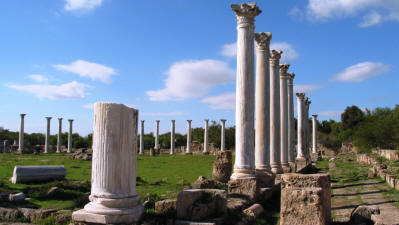 |
| The Roman City of Salamis, Near Famagusta |
In AD 46 Paul and Barnabas, a native of Salamis, travelled to Paphos where they revealed the gospel to the Roman governor Sergius Paulus. He was converted, and thus became the world's first Christian ruler. Barnabas later preached in Salamis where he was eventually martyred by the Jews.
The mission of Paul and Barnabas was to have far reaching implications, enabling the church in later years to demonstrate its apostolic origin and justifying its claim to be independent of the patriarch of Antioch.
After their revolt was crushed in Jerusalem in AD 70 by the Romans, many Jews settled in Cyprus, particularly in Salamis. Here in AD 115, they rebelled again, and the ensuing carnage over the next two years prompted the decree from Rome expelling all Jews from the island.
For the next 50 years Cyprus enjoyed unparalleled prosperity, but the degeneration of the Roman Empire left the country in a sorry plight. Fortunes revived under Constantine the Great (324-337), who tried to bind his empire together with the glue of Christianity, but in AD 364 the empire split, the eastern half being ruled from the new capital city of Constantinople, located on the Bosporus.