
A Brief History of Cyprus
Byzantine Period (330 - 1191)
With the foundation of Constantinople as the Roman capital in the East, the recipe was writ for a synthesis of Roman civic thought, Greek philosophy, and oriental Christian religion. Salamis, resuming its role as capital, was rebuilt by Constantius 11(337-361), and renamed Constantia.
Since its adoption by Constantine as the official religion, Christianity spread rapidly throughout the empire. In 431 a dispute arose between the bishops of Cyprus and the patriarch of Antioch, who claimed ecclesiastical jurisdiction over the island. The independence of the Church of Cyprus was eventually confirmed by the Byzantine Emperor Zeno in 488, after Anthemios, bishop of Constantia, presented Zeno with reliquies of St.Barnabas, the location of which was revealed to him in a dream.
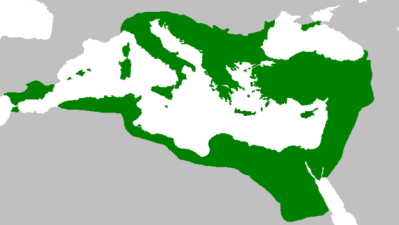 |
| The Byzantine Empire at its Greatest Extent |
For the next hundred years Cyprus lay quiet and undisturbed. But out of the wastes of Arabia a new and potent power was gathering its forces. Islam spread like a forest fire throughout Syria, Palestine, and Egypt, and in 649 an Arab fleet of 1700 ships appeared off Salamis. The city was sacked and other towns were plundered and burned. From the 7th to 10th century the island was repeatedly subject to Arab raids, and at times, tribute was paid to the Caliphate as well as taxes to Constantinople. During this period many towns were abandoned and most ancient and early Christian buildings were destroyed. The inhabitants of Salamis/Constantia finally moved out and settled in Arsinoe, which later became Famagusta.
The devastation did not end until Emperor Nicephoros Phocas finally gained the ascendancy, driving the Moslem invaders from Cyprus and other parts of his realm. To protect the island from further incursion, the 11th century mountain castles of St. Hilarion, Buffavento, and Kantara were built. In addition, new fortifications for Kyrenia and Nicosia were constructed
During this time there was a split between the Orthodox and Latin churches. The head of the Orthodox church had warned his people against the errors of the Latin church. He was promptly excommunicated for his trouble, and this rift has caused problems ever since..
After an uneasy truce with the Muslim leader Saladin, raids from the kingdom of Jerusalem on Muslim pilgrims heading for Mecca in 1181 began to heighten tensions in the region. Events began to spiral out of control once the Christian King died of leprosy in March 1185, causing the leadership of the Kingdom to fragment. After the death of the young heir, the former King's brother-in-law Guy of Lusignan was crowned King in 1186.
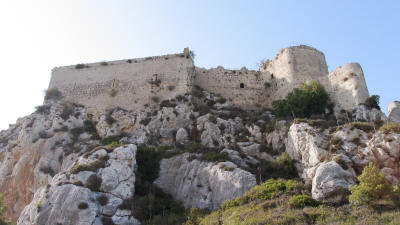 |
| Kantara Castle |
This caused dissension among the crusaders. Guy was hated by powerful rivals for the crown and, when he came to the throne he was unable to exercise any real control over his kingdom. By this time the great Saladin had welded the Moslem nations together and embarked on a jihad to recover Jerusalem. The tide had turned, and Saladin at last delivered his attack with united forces and with a spirit equal to that which had fired the Christians of the First Crusade, for to the Moslems also Jerusalem was a holy place.
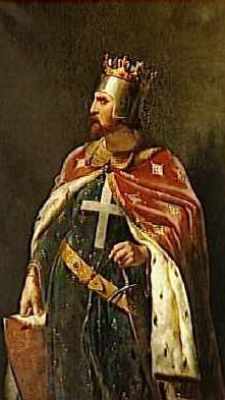 |
| Richard the Lionheart |
In 1187, the army of Guy de Lusignan was utterly defeated and, after a fortnights siege, Jerusalem was taken. Of the kingdom itself nothing was left except the city of Tyre, together with the principalities of Antioch and Tripoli in the north. The fall of Jerusalem sent a shock throughout Christendom.
The news of the fall of Jerusalem shocked the European powers, who organized the Third Crusade. The Germans went by land, but the French, led by Philip II, and the English, led by Richard the Lionheart elected to travel by sea to Acre. On the way, Richard's fleet was scattered by a storm; several ships foundered off the coast of Cyprus, and the one in which Richard's fiancée was sailing, took refuge in the harbour at Limassol. The year was 1191, and the self proclaimed emperor Isaac Commenos was ruling Cyprus. He made the fatal mistake of arresting Richard's shipwrecked sailors, and abusing his fiancée Berengaria. When Richard arrived a few days later, he landed in force, and seized Limassol. Isaac capitulated, and swore allegiance to Richard, but immediately broke his oath, and fled to Kantara. He was eventually captured at Cape Andreas in the Karpaz by Guy de Lusignan, who had arrived in Cyprus to join Richard.
A year later Richard sold the island to the Knights Templar for 100,000 Byzants.
The rule of the Templars in Cyprus was marked by great severity and they quickly incurred the hatred of the Cypriots by their harsh exactions. At length, in despair at their treatment and seeing that Templars were few in number, the islanders determined to attempt a general massacre of the knights on Easter Day, 1192. The Templars became aware of the plot and took refuge in their stronghold at Nicosia, since they were too few to meet the insurgents in the open. They offered to leave the island if their lives were spared, but as this offer was rejected, they determined to fight rather than to be starved into submission.
Sallying into the streets at dawn, they took the Cypriots unawares and slaughtered great numbers, sparing neither age nor sex. The rebellion was crushed, but the Templars felt unable to hold Cyprus by force and they therefore begged Richard to take back their purchase. This he agreed to do, and the Templars retired to Syria, retaining, however, some of their possessions in Cyprus.
On the death of his wife Sybilla, Guy de Lusignan's claim to the crown of Jerusalem weakened, and he was deposed by the barons. To compensate his loss, Richard offered him the island of Cyprus, and thus began the Lusignan dynasty, which was to endure for 300 years.