
A Brief History of Cyprus
Ottoman Period (1571 - 1878)
The peace treaty was concluded in March 1573 with Venice agreeing both to pay a heavy war indemnity sufficient to defray all the Sultan's expenses incurred in the conflict, and also to renounce all Venetian claims to Cyprus. The takeover by the Ottoman Empire was largely welcomed by the local population, who had to some extent collaborated with the invaders and who anticipated changes for the better. To begin with, their hopes were justified. It must be remembered that the Venetians were foreign feudal landlords in Cyprus, and the first step of the Ottoman governors was to abolish the feudal system, giving the freehold of the land to the peasant families who had worked it.
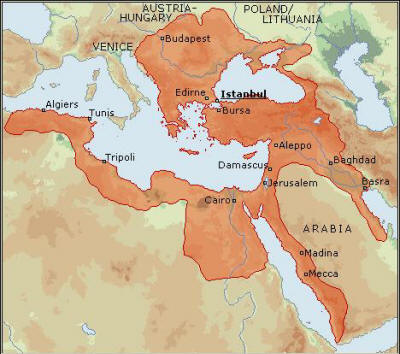 |
| The Ottoman Empire Around 1680 |
The Orthodox Church was freed from centuries of control by the Latin hierarchy and its previous tradition of independence reasserted under a revived archbishopric. On the other hand, the Catholic Church of the Crusader and Venetian rulers were expelled. Its building were confiscated and converted into mosques, or were sold to the Orthodox Church. They also made being Catholic a punishable offence, so Catholics had to choose between conversion to Orthodox Christianity, to Islam, or exile. The majority chose Christianity, but the result was that the population began to take on the ethnic structure it still possesses today, namely Greek and Turkish.
Following the defeat of the Venetians, Lala Mustafa Pasha, the Turkish Commander, chose 12,000 foot soldiers to remain on the island for the formation of the defensive garrison of Famagusta, Nicosia and Kyrenia. The military forces were complemented by an additional 20,000 decommissioned soldiers and 2,000 cavalry remaining as colonists. These people as a whole formed the original nucleus of the fledgling Turkish-Cypriot community whose members were of Turkish origin. Steps were also taken to assist all soldiers with dependents on the mainland to bring their wives and children to Cyprus.
Nevertheless, in the opinion of Sinan Pasha, who replaced Lala Mustafa Pasha, the island was still heavily in need not only of more residents in general but also of skilled craftsmen. Consequently, a decree was issued calling for a population transfer. In this instance Sultan Selim II recommended the transfer of one in every ten families from the area of (modern) southern Turkey. It was further stipulated that their properties should be sold for their actual market value and that all monies thereby accruing should be given to them for their use in Cyprus. Furthermore, in order to provide additional assistance, they were to be exempt from all taxation for the initial three years of their residence in Cyprus.
In order to assure the effective development of the island, those individuals sent to Cyprus were, as part of the relocation programme, screened as to their moral integrity, two witnesses being required to testify to their character. In addition, efforts were made to obtain craftsmen representing a wide range of skills known to be of short supply on the island. Also efforts were made to transfer families with many young daughters so as to provide spouses for unwed ex-military personnel. A total of 5,720 households were transferred in this early period and re-settled in approximately one hundred empty villages in Cyprus.
The use of resettlement as a general method for development of the Turkish population of Cyprus continued intermittently until the middle of the eighteen century. At the time of the British arrival in Cyprus in 1878 under the Cyprus Defence Alliance between Great Britain and the Ottoman Empire, approximately 95,000 Turkish-Cypriots were residing on the island.
The Ottoman conquest of Cyprus coincided with the gradual stagnation of the Near Eastern economy due to the discovery of the Atlantic trade routes in the mid-15th century. Within a century, the busy waters of the eastern Mediterranean had become a neglected backwater. Many of the islands profitable crops, such as sugar, were also ruined by American competition in the 17th century. This was partly offset by cotton plantations which tied in well with a tradition of producing fine textiles. Morphou exported linen, the Marathasa valley was known for its woollens and Nicosia famed for its silks and gold embroidery.
Throughout this period there was a series of armed tax-revolts which often united both Greek and Turk against an especially avaricious governor or an over-mighty community leader. The system of selling the office of governor (pasha), the collection of taxes by ethnic group, and the farming, or auctioning, of taxes, helped established a powerful body of community leaders on the island.
The actual governor of the island, though he commanded a small garrison of 3,000 troops, was relatively powerless. He held authority for a brief period and was principally concerned with recouping the purchase of his office with the minimum of fuss and maximum profit. He was only able to do this through the Turkish community leaders and the Greek bishops.
The archbishop grew particularly influential, and in 1660 became recognised as the official representative of the Greek Cypriots, with the rights of direct access to the Sultan's palace in Istanbul. In 1754 the archbishop was made responsible for the collection of taxes and later gained the right to appoint the head of the civil service. By the early 19th century the archbishop had almost become of greater consequence than the governor.
In 1814, Greek nationalists on the mainland formed a secret organization called the Friendly Society (Filiki Eteria). With the support of wealthy Greek exile communities in Britain and the United States, the aid of sympathizers in Western Europe and covert assistance from Russia, they planned a rebellion in order to gain independence from the Ottomans. The start of the uprising can be set in 6th March 1821 when several Greek officers of the Russian army crossed the river Prut in Romania. Simultaneous risings were planned across Greece, including in Macedonia, Crete and Cyprus.
The archbishop of Cyprus, along with other clergy and leading Christians, were discovered to have connections with Filika Eteria. The response of the governor was swift and bloody. The archbishop, the bishops, and many prominent Christians were massacred, and this was followed by an island wide purge of the Christians. Some escaped by fleeing the country, or by taking refuge with the European consuls in Larnaca.
Meanwhile the vast Ottoman Empire was showing signs of disintegration. After crushing the Greek revolt with the help of the Egyptian governor, Mohammed Ali, the European powers intervened, resulting in the creation of an independent Greek kingdom in 1832. At the same, time Mohammed Ali inflicted defeat on his Ottoman masters and established an independent dynasty in Egypt.
War with Russia, which had continued off and on since 1769, when the Russians won access through the Bosporus, was weakening the Ottoman Empire, and after further defeats in 1877, chunks of Anatolia were ceded to the Russians. This alarmed the English, who saw the Russian advance as a threat to the Suez Canal which had been opened in 1869. An agreement was subsequently reached in 1878 whereby England would occupy Cyprus, using it as a base to protect her own interests and to defend Ottoman territory against further encroachments by Russia.