
A Brief History of Cyprus
French Period (Lusignan Dynasty, 1192 - 1489)
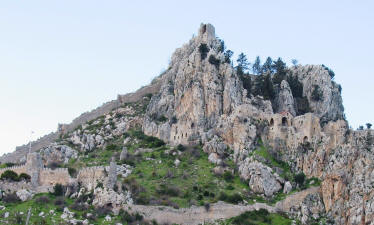 |
| St Hilarion Castle |
Guy de Lusignan introduced the feudal system, granting estates to the barons who had accompanied him from Palestine. Constitutional and legal matters were dealt with by the Assizes of Jerusalem, a code adopted from the former kingdom, but local laws and customs were retained.
Two years later, in 1194, Guy died and he was succeeded by his brother Amaury. To ratify his right to rule, Amaury obtained a crown from the Holy Roman Emperor, Henry VI, and in 1197 became the first Lusignan king of Cyprus. To secure his position from without and within Amaury extended the mountain castles of St. Hilarion, Buffavento, and Kantara. He also took steps to displace the Orthodox Church introducing the Roman communion.
Oppression of the Orthodox Church was supplemented by decrees issued at the Council of Famagusta in 1222. The Orthodox sees were reduced, and the four remaining bishops packed off to country towns. Orthodox revenues were allocated to the Latin Church, and in general, the Orthodox Church was placed in a Latin strait-jacket.
 |
| Kyrenia castle |
Rivalries between the mercantile powers erupted at the coronation of Peter II as king of Jerusalem and Cyprus in Famagusta in 1372. A dispute between the representatives of Genoa and Venice as to who should lead the king's horse resulted in a brawl, and the hostilities were continued after the celebrations when the Venetians, with tacit Cypriot support, attacked the Genoese, killing several, and destroying their property.
The Genoese responded with an iron fist. Troops were despatched, Famagusta and Nicosia were seized, along with the young king. James, The constable of Cyprus, and Eleanor, the king's mother, retired to Kyrenia castle which withstood all Genoese assaults. A treaty in 1374 restored Peter to the throne, but Famagusta was retained by the Genoese and James was kept hostage in Genoa until he succeeded to throne in 1385.
Raids on Egypt by Janus (1398-1432), aroused the wrath of the Mamluks, who descended upon Cyprus in 1426 and annihilated a weakened Cypriot army, sacked Nicosia, and imposed tribute on the island.
The Lusignan dynasty never recovered. Intrigue within the royal family weakened its position. The illegitimate usurper James II managed to wrest Famagusta from the declining Genoese. However, marriage to Caterina Cornaro of Venice was a fatal error. The Venetians, who had long coveted the island, soon engineered the king's death and effectively ruled Cyprus until they officially took over in 1489, when Caterina was persuaded to relinquish her position in their favour.