
Vouni Palace
Near Lefke, North Cyprus
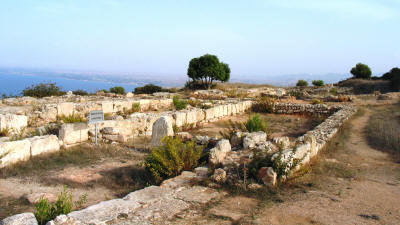 |
| Vouni Palace |
Around 600BC, the city-states of Cyprus were split between those that leant towards the east and the Phoenicians, and those that were more Greek supporting. During the great wars between the Greeks and the Persians, the city-states of Cyprus were politically divided. The Phoenicians supported the Persians, and this resulted in battles between the island's kingdoms.
Battles on land and sea were waged, and in 500BC a pro-Persian city, Marion, not only besieged Soli, but kept an eye on it by establishing a settlement on a nearby hill. This settlement was Vouni.
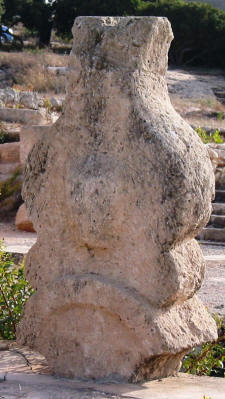 |
| Stone Stele |
In 449BC, however, the Persians were defeated by the Greeks, and the pro-Persian inhabitants of Vouni were replaced by Solians. In 391BC, Evagoras seized the kingdom of Salamis, and attempted to extend his control to the entire island. Soli and some other cities had to ask for help from the Persians to fight against Evagoras. With the help of the Persians, Soli regained its political power.
In 380BC, the palace which had been a continuous threat to Soli, was mysteriously destroyed by fire, and the inhabitants evacuated. Hence the history of Vouni lasts only 120 years.
In the beginning, the palace was little more than a military settlement, but after 449BC, when Greek rule was established, the ruler of Marion was replaced by a pro-Greek prince, and Vouni became a royal palace.
Excavations have shown that there were four different construction periods. The first construction was in 500BC when the core of the palace was built. It consisted of state apartments, large store rooms and bathrooms. During the Persian period, between 500 and 450BC, some minor changes were made.
During the Greek rule between 450 and 390BC, there were major alterations, and a second story with mud brick walls was added. Further minor alterations were made between 390 and 380BC.
The palace complex you see today is made up of three terraces. The highest point has the Athena shrine. Very little remains of this.
The middle terrace has the palace and religious buildings. The palace is believed to have had 137 rooms. There is a fountain in the middle of the courtyard, which is surrounded on three sides by rooms. The water needs of the palace were fulfilled by storing rain water in numerous cisterns which dot the site.
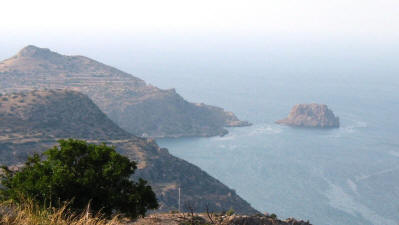 |
| Petra Tou Limnidi |
The large standing stone stele standing by the cistern in the courtyard was designed to hold a windlass, and is believed to have been brought here from elsewhere. This stone has become the symbol of Vouni. There are also food storage rooms where amphorae were found. Most of the rooms on the eastern side are used for storage, but baths were also found on this side. These baths are some of the earliest examples of fully equipped Roman baths.
The lower terrace faces the sea, and contains houses with stone bases and mud brick upper storeys which housed most of the residents. The excavations in the 1920s unearthed a baked clay cup, blackened by the fire which destroyed the palace. In addition, gold and silver bracelets, silver bowls, and hundreds of coins bearing the stamps of Marion, Kiton, Lapithos and Paphos were discovered.
From the palace, you can see the small island of Petra Tou Limnidi. This is one of the oldest places in Cyprus to be inhabited, and was excavated at the same time as Vouni. Archaeologists found items going back to the Neolithic age, consisting of bone needles, stone utensils, farming tools , and sculptures.
Until recently the ascent to Vouni would have needed a 4x4 vehicle, or a long hike. However the track has recently been surfaced and although steep and narrow, is easy. Even if you have no interest in ancient remains, the trip is well worth it for the views alone.
See the location on Google maps
Back to Lefke index.