
The Ruins of Soli
Near Lefke, North Cyprus
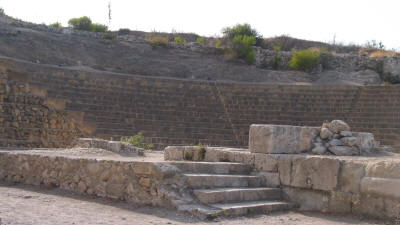 |
| Soli Theatre |
Soli is an ancient settlement, one of the ten ancient kingdoms of Cyprus, and is located in the north-western part of the island, just outside the village of Gemikonagi, on the coast near Lefke. Its history can be dated back to the 11th century BC. It was probably established here because of a good water supply, fertile soil, an abundance of copper deposits, and a protected harbour.
The city we can see today, was built around the 6th century BC, and is thought to have been named after the Greek philosopher, Solon. Soli was one of the most important capitals of Cyprus because of its port facilities and fertile soil.
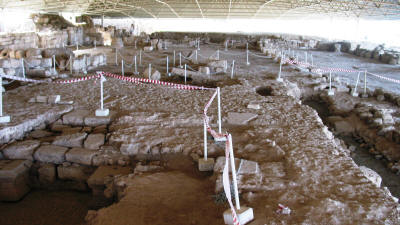 |
| Soli Church |
In 498BC, the people of Soli joined the other kingdoms in the Ionian Revolution against the Persians, but the Persians took the city. The city was liberated in 449BC, and during the Roman period, Soli became a prosperous city, expanding towards the sea. Over time, however, the city lost its importance. The copper mines were closed in the 4th century, and the harbour gradually silted up. The city was finally destroyed during the Arab raids of the 7th century.
As with many ancient ruins, the stones of Soli were re-cycled, those of the theatre being used by the British, for the construction of Port Said in Egypt in the second half of the 19th century.
Excavations at Soli in the 1920s have unearthed a theatre, temples, palace ruins, agora, church and necropolis. After the excavation of the theatre building, the Isis, Aphrodite and Serapis temples were unearthed. The Aphrodite temple is situated on a hill above the theatre, but is not accessible by the public. A sculpture of Aphrodite dating back to the 1st century was found here, and is now exhibited at the Museum of Cyprus in South Cyprus. The palace buildings from the Helenistic period are also on this hill.
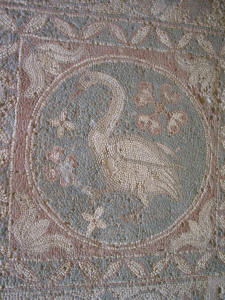 |
| Swan Mosaic |
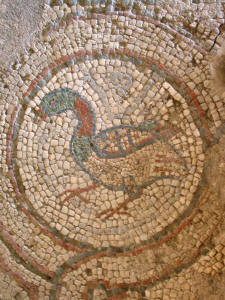 |
| Bird Mosaic |
Excavations continued in the 1960s by Canadian archaeologists. They unearthed the early Christian church, and tombs from the Geometric and Roman periods. they also unearthed the city agora with the remains of a marble fountain, shops dating back to the early Roman period, and ruins from the Helenistic period.
Most recently, excavations by TRNC archaeologists in 2005 have unearthed more tombs. One tomb that was carved into the rocks is famous for its three tomb architecture, and is thought to have belonged to a noble. This tomb housed a golden throne, diadem and gold jewellery as well as other metal cups, which are exhibited at the Guzelyurt Museum of Archaeology.
The theatre that can be seen today, is a Roman structure, built on top of a Greek theatre facing the sea. It dates back to the end of the 2nd century AD. The stage was in two stories, covered with marble panelling and decorated with statues. The seats for the spectators were carved in a semicircle on the rocks of the hill, and the entrance to both those and the orchestra was by two side entrances. The audience was separated from the orchestra in the middle by a limestone wall (now part of Port Said harbour). The theatre had a capacity of 4000, and has been restored to half its height. Some of the original masonry can be seen in the orchestra section.
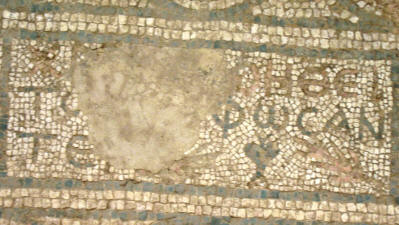 |
| A Mosaic Inscription |
The restored theatre is still used for the occasional concert.
During the early days of Christianity, Soli became an important Orthodox centre. In 325AD it had been represented by three bishops in the Nicean council, and 12 bishops in the Sardes council.
According to Christian tradition, Soli is believed to be the place where St Mark was baptised by St Auxibus, A Roman Christian who later became the first bishop of the church of Soli.
The church was built in many different stages. The first building was a five naved church, and a coin found here dates the church back to the 4th century AD. Later in the 6th century, the church was turned into a three naved church. The three naves were separated by twelve columns, and the large columns are still standing today.
Mosaics, dating back to the 4th century, were found on the floor. These are decorated geometric patterns, as well as animals such as birds and bulls. Among the animal figures were vines and a swan. In the apse, there is writing decorated with geometric figures. The writing says "Jesus! Protect those who built these mosaics".
See the location on Google maps
Back to Lefke index.