
Vrysi Settlement,
Catalkoy, Near Kyrenia, North Cyprus
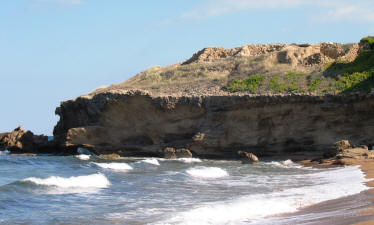 |
| The Eroding Headland at Vrysi |
People from all over the Mediterranean have made their homes in North Cyprus for centuries. This small Neolithic settlement (sometimes also called Catalkoy after today's local village), dates from between 4000 and 3000BC. It was built by settlers from a district in Anatolia called Kilikya.
The economy of the settlement appears to have been based on agriculture. Artefacts such as stone axes, grinders and bone needles have been found, as well as the remains of wheat, barley, lentils, grapes, and olives. Archaeological evidence suggests that the villagers were skilled weavers and potters. Their handmade pottery is decorated with bold designs in dark red, or brown on a white surface.
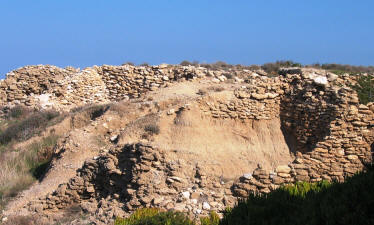 |
| Houses at the Settlement |
The Vrysi houses were built in man-made or naturally formed hollows, and are generally below ground level. It is thought that the reason was for protection against bad weather conditions and as a way of hiding from strangers. Excavations have revealed a total of 17 houses, separated from each other by narrow streets. The inner walls were plastered with clay. Earlier houses were very weak, but the later ones were much stronger. The floors were mud or clay covered with woven mats of plant fibre. Roofs were of reed, and each room had a raised hearth.
The original settlement had a fortified ditch for protection, but as that became unnecessary, new houses were built beyond it. Following an earthquake, the people of Vrysi abandoned the settlement and moved elsewhere.
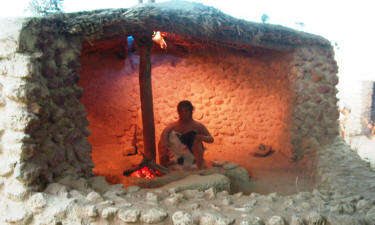 |
| A Reproduction House (Displayed at Kyrenia Castle) |
The site was excavated in 1972 and 1973 by a team of archaeologists from the Universities of Glasgow and Birmingham. Abundant examples of ceramic pieces, stone lamps, grinding stones, waste chippings, flint stone tools, bone needles and stone weights were found at the site. Bones of sheep, goats, pigs, deer and dogs were found as well as remains of wheat, barley, lentils, olives, figs and grapes. From these findings, it has been deduced that the people who lived in Vrysi knew how to make ceramics and practiced skills in cattle breeding, hunting, fishing and agriculture. No remnants of graves or graveyards have been found on the site, but as only 575 square meters have been excavated , there is still hope that findings concerning burial traditions will be made in future excavations.
The objects found have been classified, and are on display at the Vrysi archaeological museum which was opened on the 22nd December 2006 at Kyrenia Castle.
Vrysi sits on a headland at the eastern end of Acapulco Beach. At first sight, the promontory appears to be falling into the sea. Sadly, first sight is proving to be correct, and the exposed house walls are gradually crumbling away. Over time, erosion of the promontory itself will probably mean the site will disappear into the sea.
See the location on Google Maps
Back to Kyrenia index.