
Kyrenia Castle
Kyrenia, North Cyprus
Kyrenia castle, which dominates the old harbour, is the most complete castle on the island, rivalled only by the citadel of Famagusta. It is thought to have been built by the Byzantines around 700 to protect the town against Arab raids. It was, however, built over an older, Roman, structure.
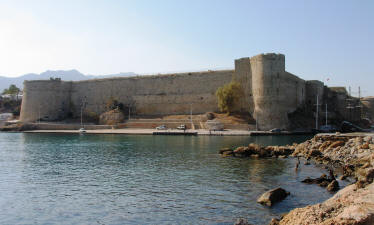 Kyrenia
castle Kyrenia
castle |
In 1191, Guy de Lusignan seized the castle from the self-proclaimed king of Cyprus, Isaac Commenos who was in hiding at Kantara, but had left his wife and daughter at Kyrenia. Like Kantara Castle, it played an important role during the Lusignan period, and the castle underwent a lot of changes due to restoration work. The castle was further extended by the Venetians, and the bulk of what can be seen today is the Venetian structure.
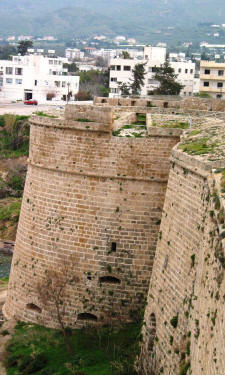 |
| Venetian South East tower |
The main features of the exterior are the round towers built by the Venetians. As soon as they took over Cyprus, the Venetians feared that the Ottomans, who were on the mainland just a few miles away and rapidly gaining strength, presented a potential challenge to their ownership of the island. This was a time when warfare was moving away from knights and archers, and gunpowder, cannon and the use of artillery was being developed. It was obvious to the Venetians that the old crusader castle simply would not stand up to such an attack, so they strengthened and widened the walls by simply filling in the space between the compact Byzantine walls and the over extended Lusignan walls. (You can still see an example of a superfluous Lusignan round tower stump in another part of Kyrenia).
Round towers, which had proved to be stronger than square towers against cannon fire, were built at the corners. They built numerous gun ports at three levels where cannon fire could be directed at attackers from the land. Inside the castle, long ramps were built so that the artillery could be rolled up to the gun ports on the walls.
Inside the Venetian castle can be seen the remains of the Lusignan castle. In places you can see stone balls about the size of footballs. Although looking as if they could be cannon balls, they are in fact, stone missiles used by machines such as the trebuchet.
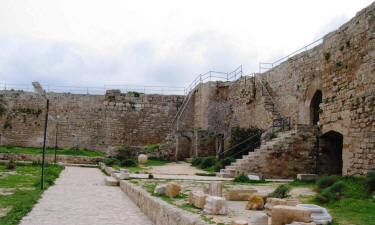 |
| Castle Courtyard |
The third, and oldest, castle is from the Byzantine period, although there is not much remaining of this. However the Byzantine church of St George which was used by the Knights Templars and dates to around 1170 is still visible. For hundreds of years this church stood outside the castle walls until the Venetians enclosed it with their huge north west tower. Nearby you can see a horseshoe-shaped tower inside the Lusignan tower which forms the old gateway. This Byzantine tower is built of rough rubble and is rather small compared with later towers.
There is nothing left of the Roman castle which dates back earlier than 330BC.
The castle was never taken by force, repelling attacks by the Genoese in 1374, and the Mamluks of Egypt in 1426. However in 1570 the Ottomans induced the defenders to capitulate by sending as a threat the severed heads of the Venetian commanders of fallen Nicosia. Thus the massive Venetian towers were never put to the ultimate test.
The castle was used as a prison at various times during the Lusignan period, and by the British early in their administration, and again between 1954 and 1960 for EOKA captives. Although it was open to visitors during 1963 to 1967, a large portion of it was used by the Greek National Guard as a military headquarters.
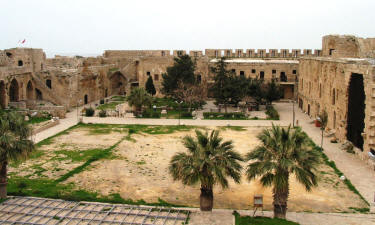 |
| The Parade Ground |
Today you enter the castle via a bridge over a road which was originally part of a moat and used as an inner port till around 1400. On the left as you enter, you will see a passage leading to the Templar church of St George which has recently been restored.
As you continue up the slope to the parade ground, you will pass the tomb of the Ottoman Admiral, Sadik Pasha, who took Kyrenia in 1570. The parade ground is lined with guard rooms, stables and living quarters. Ramps lead to the upper sections of the walls, and the views from the top make the climb worthwhile.
The Lusignan north east bastion is home to a permanent display of military history, with the armour and arms of each period in the castle's life, from Byzantine to British. In the tower there is a mock-up of a Venetian cannon crew in action.
To the east of the courtyard there are two superb archaeological exhibits. The first is the Tomb-Finds Gallery, comprising three major exhibits spanning the Neolithic, Bronze Age and Hellenistic to Byzantine periods. Next door, the Shipwreck Museum displays a cargo boat which sank just off Kyrenia some 2300 years ago, and is the oldest shipwreck known.
See the location on Google Maps
Back to Kyrenia index.