
The Shipwreck Museum
Kyrenia, North Cyprus
Located within Kyrenia Castle, the Shipwreck Museum displays a cargo boat which sank just off Kyrenia some 2300 years ago. It was discovered by a local sponge diver over 30 metres down in 1965, and was salvaged between 1967 and 1969 by marine archaeologists from the Pennsylvania University. It is the oldest shipwreck known, and carbon 14 dating indicates it was built in 389BC, around the time of Alexander the Great.
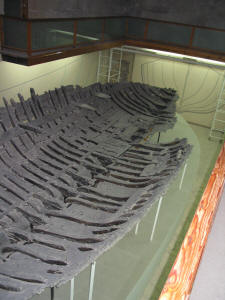 |
| The Kyrenia Ship |
While ancient shipwrecks have been found all over the Mediterranean, virtually nothing of the ships themselves have survived. The Kyrenia ship is different. Aided by currents, a protective layer of sand built up round the ship soon after it reached the sea bed, blocking oxygen and sea life from attacking its timbers and keeping the ship from destruction.
Having remained underwater for so long, the ships timbers had undergone cellular breakdown, and had the consistency of wet bread. Preservation involved impregnating the wood with polyethylene glycol to give it solidity and prevent shrinkage.
The ship was built in the "shell first" manner, the opposite of today's method. Instead of building a skeleton of ribs first, her outer planking was built up from the keel, and then the ribs were laid in, being secured with copper spikes. The ship was intended for a long service and underwent many repairs. In the last batch of repairs, a skin of lead sheeting was applied to her body to keep the ship waterproof. When she foundered, the ship had been in service for at least 8o years.
Initially it was thought that the ship had sunk because of old age, perhaps compounded by a slight collision or wave stress. However the discovery of iron spearheads underneath the hull and embedded in the side of the ship led to the conclusion that the ship had been attacked and sunk by pirates which were active round the North Cyprus coast. This would also explain the lack of the crew's remains or of their personal effects, as the pirates probably plundered the ship and took the crew prisoner to be sold as slaves.
The boat had just plied the coast of Anatolia, judging from freight from Samos, Kos and Rhodes (most of it stone grain grinders which could double as ballast), and nearly 400 amphorae of wine. About 300 lead weights show that the ship was also used for fishing.
The ship is 15 metres in length, made of Aleppo pine, and was open with short decks in the bow and stern. The wooden surface of the ship is coated with a strong lacquer to protect it against Mediterranean wood-boring maggots. The number of kitchen utensils, wooden spoons, olive oil bottles, glasses and salt cellars, show that the ship had a crew of only four persons. They subsisted mainly of almonds, large quantities of which were found intact, and such fish as they were able to catch.
The upper levels of the exhibit hall shows photos of the archaeological dive, and lead to the viewing platform over the wreck itself, soaked in preservative and kept in a cool, dry, dimly lit environment now that it's out of protecting seabed mud.
After recovery, reconstruction of the wreck took nearly 6 years, and the museum was finally opened to the public in March 1976.
See the location on Google Maps
Back to Kyrenia index.