
Buyuk Hamam (Great Turkish Bath)
Nicosia, North Cyprus
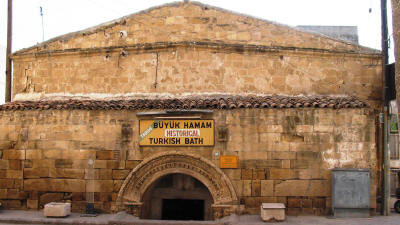 |
| The Buyuk Hamam |
The Buyuk Hamam, or Great Turkish Bath, is built on the ruins of a 14th century Lusignan church, St George of the Latins. Only the entrance of the church remains, but it bears similarities to the porch of the Bedesten.
The building was converted into a bath house when the Ottomans arrived in Nicosia in 1571. Being one of the most frequented Turkish Baths open to the public, its services were very important, particularly as there were no baths in most houses. With its lukewarm, cold and hot areas, it was a standard Turkish bath.
The baths consist of a changing room, and warm and cool sections. The reception area is covered by a wooden roof on two pointed arches. This area has divans along its walls and an octagonal cistern in its centre. Alongside the reception area are two smaller anti-rooms with four recesses which lead to the vaulted caldarium (hot room) with recesses and a stone bench at the centre. The caldarium extends to two small side chambers. Light is provided by the glass-covered holes on the bell-shaped cupola.
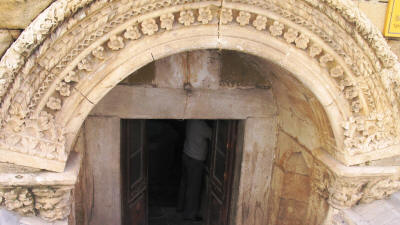 |
| The Sunken Entrance to the Buyuk Hamam |
A particular feature of the building is that it is two or three metres below road level. For thousands of years, new towns were built on the ruins of old ones, so the ground level became higher and higher. Nicosia is no different in that respect, but the raising of the ground level is particularly noticeable here.
The Buyuk Hamam is one of the two remaining Turkish baths that still function. However, because of a long term lack of maintenance, the original hypocaust system at the base of the bath ino longer worked. However, with aid from the United Nations, the Buyuk Hamam was restored and made fit for present day sanitation standards, while also getting a modern infrastructure system.
It is hoped that in restoring this important monument, which represents a vital aspect of the cultural life of all Cypriots, it will promote the establishment and expansion of inter-communal cultural preservation.
The hamam is open daily except Monday from 9am to 9pm. Most morning sessions (9am-3pm) are segregated. Tuesday, Thursday, and Sunday are restricted to males, and Wednesday and Saturday for women. The afternoons and all day Friday are family sessuons.
See location in Google maps.
Back to Nicosia Index.