
St Mamas' Monastery
Guzelyurt, North Cyprus
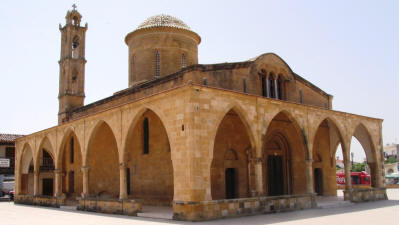 |
| St Mamas' Monastery |
The church in the monastery was originally a Byzantine building, built on the site of an Aphrodite temple. It has been reconstructed at various times over the centuries, with most of the buildings dating to the 18th century when the large central dome was added. However, the side portals and columns of the nave survive from an earlier Gothic church built by the Lusignans.
 |
| St mamas on His Lion |
It is said that Mamas was a Christian saint from Anatolia who was killed on religious grounds. His family, aided by Jesus Christ, placed Mamas in a coffin and buried him at sea. The coffin, swept away by the tide, made its way to the Gulf of Morphou (now Guzelyurt), where it was found by a humble man who lived in the area. The man returned to his house and gathered two oxen and called for his four sons to accompany him to the place where the coffin had landed. Tying a rope to it, they tried to pull the coffin away. However, the man, realising the coffin was heavier than he had initially thought, called for help. The coffin was eventually taken with great difficulty and effort, and when the coffin could be carried no further, a church was built round it.
Another legend has Mamas as a 12th century saint who lived in a cave near Guzelyurt. the Byzantine duke of the time demanded taxes from the local population. Mamas refused to pay the taxes as he lived in a cave. The Duke commanded two of his soldiers to arrest Mamas and bring him to Lefkosa. As the soldiers brought Mamas to the city to be punished, their paths were crossed by an aggressive lion which was ready to pounce on and tear apart a lamb. Mamas, witnessed by the terrified soldiers, saved the lamb from the lion's paws and continued the rest of the journey, entering the city on the back of the lion, carrying the lamb in his arms. On seeing this sight, the Byzantine authorities were so impressed that they decided to exempt him from paying taxes for the rest of his life. Since then, St mamas has been the patron saint of tax avoiders.
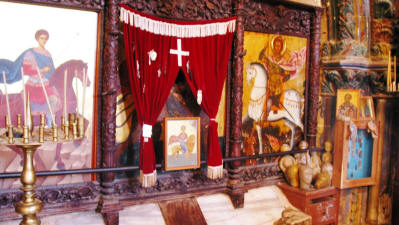 |
| The tomb of St Mamas |
The tomb of St Mamas, which is on the left as you enter by the north door, is surrounded by votive offerings, many in the shape of ears. It is said that during the Ottoman rule, believing there was treasure hidden in the coffin, they bored holes into its side, at which a sort of nectar oozed out. This balm which appeared at irregular intervals was said to give protection against earache (as well as the ability to calm stormy seas).
The icon section of the church dates back to the Lusignan and Venetian periods. On the four Venetian pillars are carved grape, fig and shield figures, as well as the Venetian coat of arms. The pulpit was built in 1711, and the oldest icon to around 1745.
Outside the church, the monastery buildings are to the north and east, and records show them as being built in 1779. Architecturally, the arches on the front of the northern buildings are quite different to those on the eastern side. The northern buildings reflect the traditional style of the complex. On the eastern side, there is a resemblance in style to 18th century Ottoman inns, with stone columns on the ground floor and timber balconies on the second.
The monastery buildings are now used for business purposes, ranging from lawyers to a television office. Pause for a while at the small coffee shop in the south eastern corner and and soak up the atmosphere. Admire the proprietor's match stick model of the mosque opposite, and you have a friend for life.
See the location on Google maps
Back to Guzelyurt index.