
St Catherine's Prison
Salamis, Near Famagusta, North Cyprus
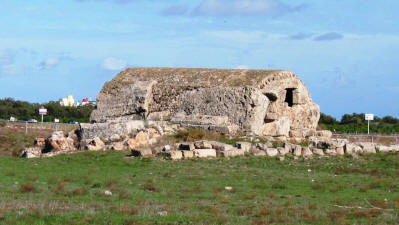 |
| St Catherine's Prison |
St Catherine's prison is officially tomb 50 within the Royal Tombs complex. So Who was Catherine, and what was her link with here?
St Catherine was a royal princess, the daughter of King Constant of Cyprus, born around 287AD. The Roman emperor at the time was Diocletian, who was known for his cruel persecution of Christians. When Constant was transferred to Alexandria to rule over Egypt, his brother became administrator of Cyprus. King Constant died soon after his arrival in Alexandria, and his daughter was sent back to her uncle in Cyprus.
When her uncle learned that she had become a Christian, he tried to convert her back to the pagan religion. Catherine was unyielding, and proclaimed her faith with such determination, that her uncle was forced to take harsh measures against her. Fearing that the emperor would put him to death for protecting her, her uncle imprisoned her first at Salamis, then at Paphos, before sending her to Alexandria.
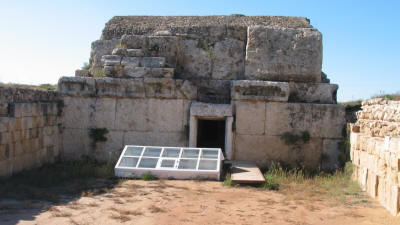 |
| Tomb 50 |
The ruler of Alexandria at the time was Maxentius, son of the emperor Diocletian, and he was as ruthless as his father. He also tried to get her to change her faith, without success, torturing her and throwing her into prison. He asked 50 philosophers and orators to convince Catherine to return to the religion of her fathers. She countered their arguments to such an extent that she converted them to Christianity. This infuriated Maxentius, who ordered that the philosophers be burned at the stake.
It is also said that when Maxentius was away from Alexandria, his queen, followed by 200 officers and men visited Catherine in prison to convince her to relent. the soldiers were so impressed by Catherine's convincing defence that they were converted to Christianity and baptised. When Maxentius heard of this, he had them all beheaded.
He finally ordered that Catherine should be severely beaten and tied to a rolling spiked wheel. Ever wondered where the firework got its name? Although she survived this torture, she was beheaded in 307.
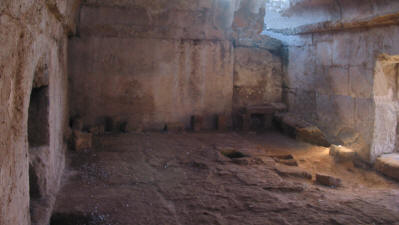 |
| St Catherine's Prison Interior |
Tomb 50 was originally built in the first half of the 7th century BC. Like the other tombs, excavations in 1965 showed that it consisted of a vaulted rectangular burial chamber with a wide dromos to the east. Two sacrificed horse skeletons and traces of a vehicle were found.
Between the 3rd and 4th centuries AD, the present vaulted chamber was constructed. It is thought that during this period it was used as a temple where you could go to remember exalted people.
Between the 4th and 7th centuries, stairs were built at the entrance to the vaulted chamber, and it became a burial ground. In the dromos, amphorae were discovered, which had been used for children's burials.
From the 14th century, the building was used as a Greek Orthodox chapel, a use which continued up until 1950.
There is no proof that St Catherine was ever imprisoned here, but the structure of the building is obviously in the style of a church. As it has been dated to the 4th century, around the time of St Catherine, the obvious conclusion is that there must have been some reason for building it here.
See the location in Google maps.
Return to Salamis Index or Famagusta Index.