
Othello's Tower (The Citadel),
Famagusta, North Cyprus
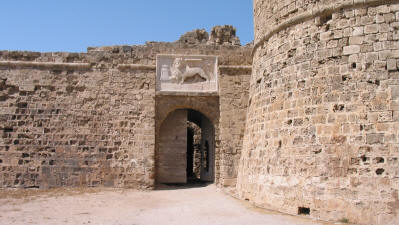 |
| The Citadel Entrance |
Othello's tower was originally built as a moated citadel in order to protect Famagusta's harbour, and was originally the main entrance to the town. When the Venetians arrived, they greatly strengthened the town's defences, incorporating the citadel into the main town walls.
The tower was remodelled by the Venetian Captain Nicolo Foscareno in 1492. Above the main entrance, there is a sculpture of the winged lion of St Mark, the patron saint of Venice, along with an inscription crediting Nicoli Foscareno with the renovation.
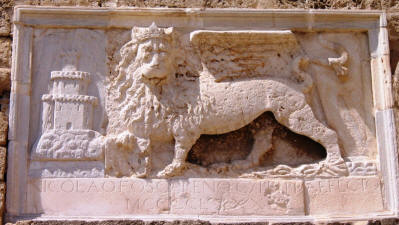 |
| Sculpture Above the Entrance |
Take a moment to look at the lion sculpture before you go through the gate. The front paws are on the land, representing Venice's land power, while the rear paws are in the sea, representing her maritime empire. Below the lion, the entrance door is one of the earliest surviving wooden doors in Cyprus.
The citadel itself, consists of towers with corridors leading to artillery chambers. In times of war they would have allowed soldiers to move quickly from one part of the castle to another. In more peaceful times they would have been used to store things that needed to be kept cool, safe and secure.
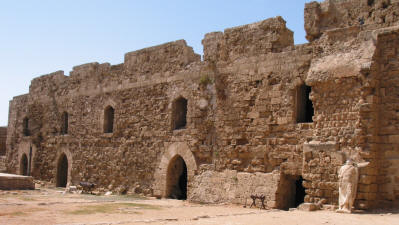 |
| The Citadel Courtyard |
In 1566, however, a visitor noted that the castle was no longer being used as a residence, but was being used by the Venetians as a prison. When you are down in the subterranean tunnels, mentally picture a door closing behind you and consider how you would have coped.
It is rumoured that the Venetian merchants, during the Ottoman siege, hid their fortunes down here and sealed the tunnels up. As they were not allowed to take anything with them when they were allowed to leave the city, these treasures are still supposed to be there.
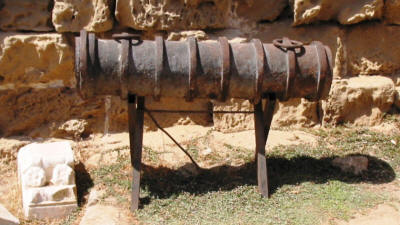 |
| An Ottoman cannon |
In the courtyard, there are old cannons lying on the ground. One of them is made of bronze and is over 400 years old. There are some iron cannon balls lying about, as well as some stone balls that would have been used in a trebuchet.
To one side of the central courtyard is a large vaulted hall with magnificent ribs, which are, sadly, gradually being eroded by the sea air. It dates to around 1300, and was used as a dining room by the Lusignans.
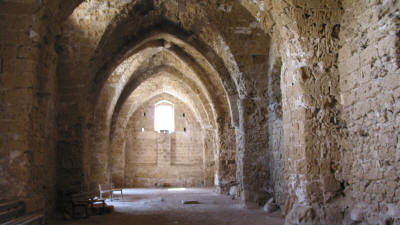 |
| The Vaulted Hall of the Citadel |
Use your imagination again, and picture the room filled with long wooden tables filled with food. Look at the tapestries and banners hanging from the wall. Listen to the musicians playing music for the French knights and nobles to dance to.
Steps from the courtyard lead up to the battlements, where you can get views of the harbour. Across the harbour you can see a clump of rocks where there was a chain tower. The chain could be lowered across the harbour entrance in order to protect it.
The courtyard and vaulted hall are still sometimes used for folklore performances.
The citadel's more common name, "Othello's Tower", originates from Shakespeare's "Othello". The play refers to "a port in Cyprus", and "Cyprus, the Citadel". It has also been suggested that the Moor in the service of Venice could have been named after a Governor of Cyprus, Cristoforo Moro. Shakespeare's play, however, is not contemporary with Venetian rule, having been written more than 30 years after the Ottomans arrived.
See the location on Google maps.
Back to Famagusta index.