
Lambousa
Alsancak, Near Kyrenia, North Cyprus
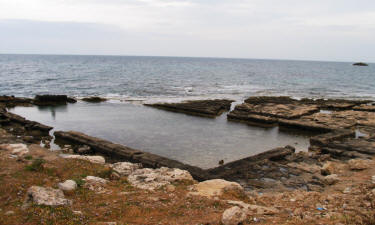 |
| Lambousa Fish Pond |
There is general agreement that Lambousa was founded as a colony of the Laconians after the Trojan war in about 1000BC. However there is some evidence from excavations that date it as early as 3000BC. In the 4th century BC, Diodoros of Sicily describes Lambousa as one of the 9 Cypriot kingdoms.
In 333BC, the king of Lambousa sent over 200 ships to aid Alexander the Great in his siege of Tyre, helping him take that city. As a reward, Alexander declared Cyprus free from Persians.
During the Roman empire, Lambousa had more than 10000 inhabitants, and experienced great commercial experience because of its harbour and as it became a centre for processing copper and earthenware.
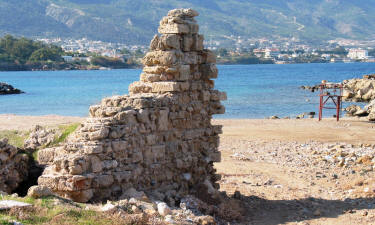 |
| Lambousa City Wall |
During the early years of Christianity, the apostles Paul, Barnabas and Mark passed by Lambousa coming from Tarsus.
Lambousa was heavily damaged during the Arab raids from the 7th century, and the population fled from the coast to safety in the hills. However when the Arabs were eventually defeated in 965, the population returned and rebuilt their city further inland.
The town wall, the rock graves and the fish tanks are among the ruins that have survived to this day, and some archaeological work has taken place since 1992.
The fish tanks, or fish breeding tanks are known to be the earliest examples of their kind. There is, however a school of thought that rather than Byzantine fish tanks, has them as a bathing establishment, part of a Roman villa. They are cut into the rock near the harbour, and are designed in such a way that while cool, fresh water entered into them with the tides, the warmer water went out through another channel.
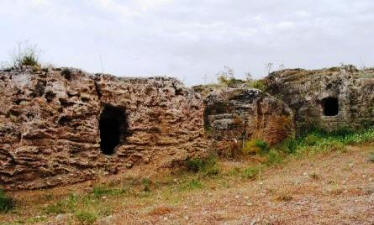 |
| Rock Tombs |
When the inhabitants abandoned the city, a lot of their treasure was buried to await their return, which never happened. The treasure of Lambousa became a legend and was almost dismissed as such until archaeologists and amateur treasure hunters began unearthing some incredible, stunning and priceless treasure from the area some 300 years later. The so-called Lambousa Treasure was unearthed by two separate groups of archaeologists. The first discovery took place in the late 19th century and the unearthed reliefs, decorative silver vases, pots and spoons with animal motifs on their rims that were found are today on display at the British Museum. (Room 41 if you're visiting). Each of these exhibits are marked with the Byzantium Imperial stamp suggesting that they were brought to Lapta from the Byzantine capital, Constantinople.
The second find took place in 1902. Two stonemasons named Kostis Karilios and Kostis Berberi were at work extracting stones from a house at the ruins of Lambousa. Under the floor of the house they discovered an urn packed full of gold jewellery. Two days later they discovered, hidden in a secret compartment in one of the walls, a collection of silver plates, today known as the "David Plates".
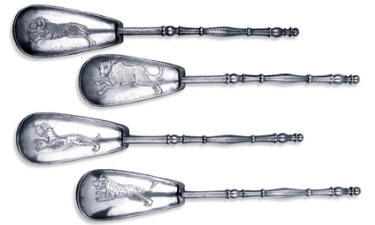 |
| Silver Spoons From the First Lambousa Treasure |
In 627, the Byzantine emperor, Heraclius, fought the Persian general Raztis in single combat and beheaded him. Afterwards, having compared his victory with that of David against Goliath, he issued some commemorative plates. These plates, the largest of which depicted David fighting the giant Goliath are considered to be amongst the finest examples of art from the early Byzantine period. Imperial stamps son the plates date them to the period 627-630AD.
The two stonemasons did not surrender their find to the authorities, but smuggled many of them to Paris. Luckily the men's plan was foiled and some of the treasure was returned to Cyprus to be displayed at the Cyprus Museum in south Nicosia. Much of the treasure that was not returned later emerged in museums in Washington, New York and London.
The Lambousa Treasure is a reflection of the high standard of early Byzantine art during the 6th and 7th centuries and is indicative of the Lambousa's wealth and level of social development at the time..
To reach Lambousa, take the coast road from Girne towards Lapta. Immediately after the turning for Alsancak, look for a road on your right signposted to the Mare Monte hotel. You will also see the signs for Lambousa. At the hotel entrance, turn left on to a dirt track towards Lambousa. You will be able to drive along this track to within a few hundred metres of the sea. If you park at the start of the dirt track, Lambousa is about ten minutes walk.
See the location on Google Maps
Back to Kyrenia index.