
Bellapais Abbey,
Near Kyrenia, North cyprus
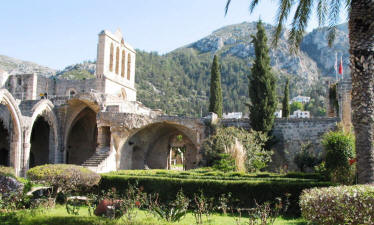 |
| Bellapais Abbey |
A few kilometres east of Girne lies the village of Bellapais, made famous by Lawrence Durrell in "Bitter Lemons". The village is in the foothills of the Besparmak mountains, on a terrace overlooking the Mediterranean, and affords spectacular views. It is dominated by Bellapais Abbey, the present day name of which is a corrupt form of the Abbaye de la Paix, or Abbey of Peace. The building is regarded as a masterpiece of Gothic art, and the most beautiful Gothic building in the Near East.
The first monks who were known to have settled here were Augustinians who had to flee from Jerusalem when the city fell to Saladin in 1187. It is known that the original construction was built between 1198 and 1205, and was originally dedicated to St Mary of the Mountain. Almost immediately they changed their affiliation to the Premonstratensian order under Thierry, the man behind the construction of St Sofia cathedral (Selimiye mosque) in Nicosia. They adopted the white habits of the order, which gave the place its nickname of the "White Abbey".
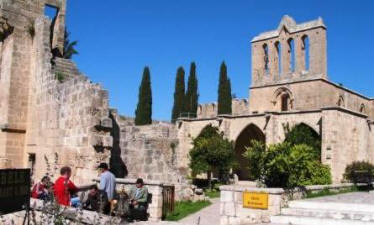 |
| The Abbey Entrance |
In 1246 the abbey rose to prominence when a wealthy knight, Roger the Norman, left them a gift of an important relic, a supposed fragment of the true cross. Pilgrims flocked to the Monastery to see the relic, spend some time in retreat, and give a generous donation at the end of their stay.
A large part of the present day complex was constructed during the rule of the Lusignan King Hugh III (1267-1284). He also conferred on the abbot the right to wear a mitre, sword and golden spurs. This and the possession of the relic, only served to heighten the abbey's sense of self-importance in its frequent squabbles with the archbishopric of Nicosia.
Subsequent Lusignan kings were benefactors, and some even lived in the abbey, which continued to expand. The cloisters round the courtyard and the refectory were constructed during the rule of the Lusignan King Hugh IV (1324-1359).
The riches of the abbey, however proved a tempting target for the Genoese plundering of 1373, and the monastery's treasury was taken, along with the precious relic. This marked a downturn in the abbey's fortunes, and it spun into a moral and physical decline. Records of the time reveal how degenerate the lives of the monks had become, for not only did they take wives, but the abbey became a centre for experimental polygamy. The friars' reputation became scandalous on account of their concubines and the fact that they would only accept their own children as novices.
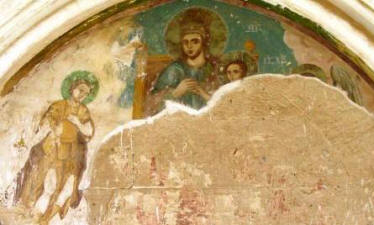 |
| Church Frescoes at the Abbey |
At its peak, during the Venetian period, the monastery was inhabited by about 50 monks. The Venetians had shortened the abbey's name to "De la Paix" which was subsequently corrupted to "Bellapais". By 1570, the abbey itself was almost a ruin.
Following the Ottoman conquest in 1571, the monks were turned out and the monastery was given to the Greek Orthodox Church. A village grew up round the monastery, and some local families today claim to be descended from those monks. The buildings fell into disrepair. The ruins were used for animal grazing, and the stones taken to build the village of Bellapais. The abbey was in danger of being totally dismantled by the British in the 1870s, but its stone was considered to be too soft for road building, so it was reprieved, and restoration was started early in the 20th century under George Jeffrey, the first curator of the Lapidary Museum in north Nicosia.
The monastery begins with a gate, and the tower is a later addition. The church which is situated on one side of the courtyard is the best preserved part of the monument, and dates from the 13th century. The church was regularly used by the Greek Orthodox community till 1976. The interior is much as the Greeks left it with intricately carved pulpit and bishop's throne still intact. Underfoot, several Lusignan kings are thought to be entombed. The murals which have survived above its facade are thought to be from the 15th century.
The forecourt leads to cloisters of 18 arches. Under one of the northern arches there are two Roman sarcophagi which once served as wash basins. The door behind the sarcophagi leads to the refectory of the monks.. The lintel above the door contains the sets of coats of arms of the royal families of Cyprus, Jerusalem and the Lusignans. This is an exquisite sample of Gothic architecture and the finest room in the monastery. The room contains a pulpit for addressing the monks during their meals. Six windows in the north wall which illuminate the room are reinforced by a rose window in the eastern wall.
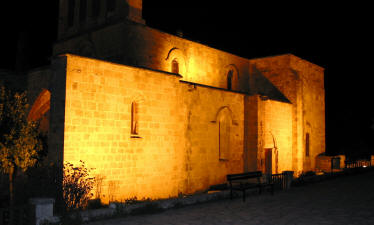 |
| Floodlit, Ready for an Evening Concert |
During the 1800s, British forces used the refectory as a shooting range, and bullet holes can still be seen in the east wall under the rose window. The refectory now hosts music festivals and concerts throughout the year.
A door in the western wall leads to the kitchen and cellar built under the refectory. The rooms between the refectory and kitchen are thought to have once served as lavatories.
The east side of the inner courtyard was occupied by the chapter house and work rooms (undercroft). The first of these functioned as the administration office of the abbey, and retains its interesting stone carving: a man with a double ladder on his back, another man between two mermaids, a woman reading, two beasts attacking a man, a woman with a rosary, a monkey and a cat in the foliage of a pear tree under which a man holding a shield is seen, and a monk wearing a cloak. The column standing at its centre is thought to have come from a notable Roman building or temple that was here about 200AD. The rooms of the monks occupied the second floor above this section.
A pair of stairs on the south of the inner courtyard led to the treasury room in the north-west corner of the monastery.
Bellapais Abbey holds a special place in the architectural inheritance of Cyprus. It is among the monuments of the many civilisations which have established themselves on the island. It is one of the few surviving examples of monastic architecture in the entire Middle East. In North Cyprus, where several buildings of the Gothic period still remain, Bellapais abbey stands to the fore.
See the location on Google Maps
Back to Kyrenia index.